Supported only from below and with nothing to cross its cage, the flying tourbillon is one of the most visually arresting of complications, its hypnotic rotation seemingly suspended in mid-air. Achieving that visual lightness, however, requires extraordinary precision and an exceptionally lightweight construction, making it a feat of both engineering and artistry. Audemars Piguet showcases the complication across four new references within the Code 11.59 by Audemars Piguet collection.
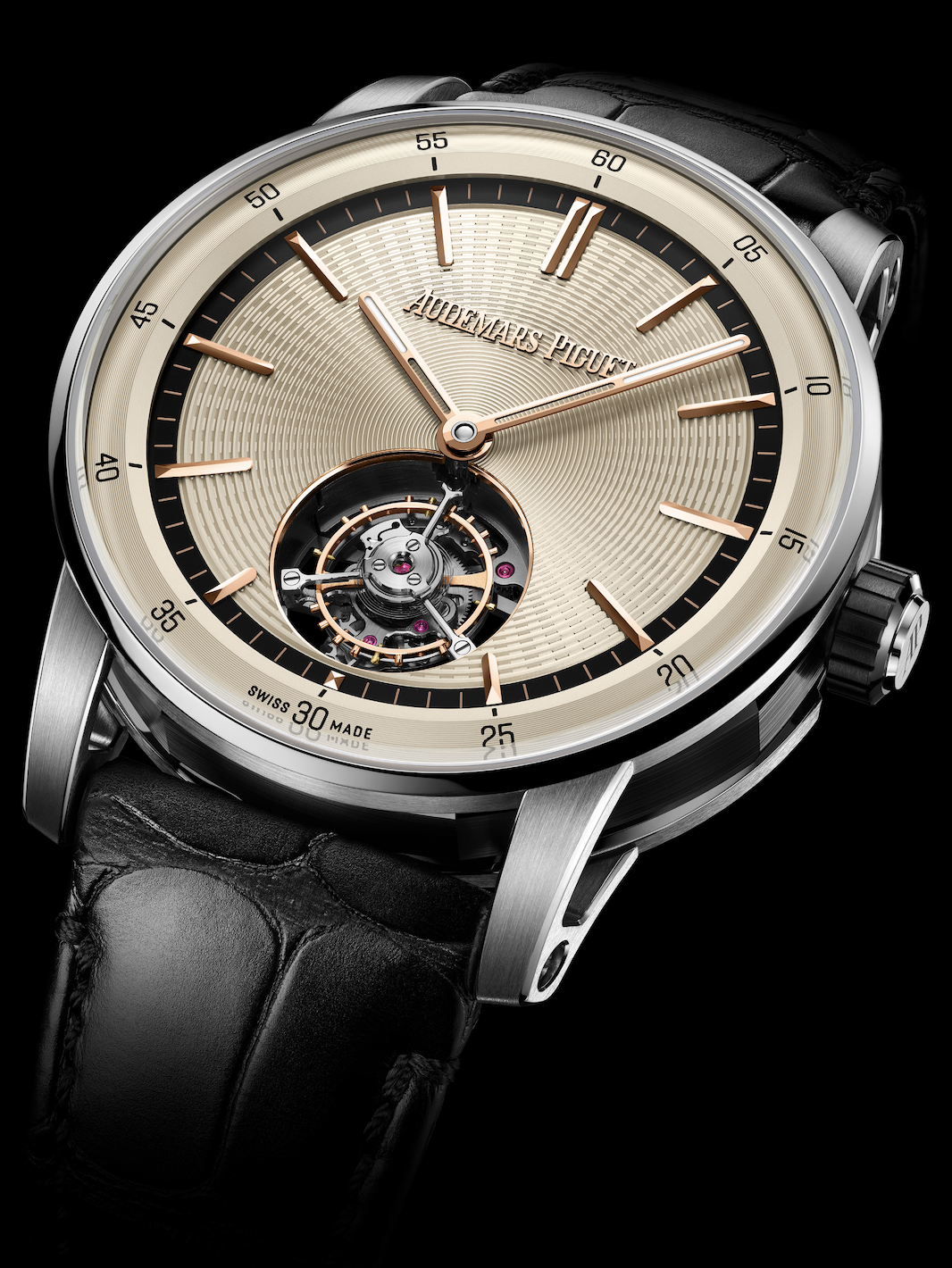 Code 11.59 by Audemars Piguet Selfwinding Flying Tourbillon 41mm black ceramic
The 41mm Selfwinding Flying Tourbillon puts the purity of its complication front and centre, with a serene ivory-toned dial providing a pared-back canvas. Its sole decoration is the collection’s signature guilloche pattern, developed in partnership with artisan Yann von Kaenel and formed from hand-engraved concentric circles enhanced with PVD colouring. Pink gold hands, hour markers, and the outer rim of the flying tourbillon aperture bring warmth to the dial, contrasted by a black ring around the indexes and a matching black ceramic case middle.
At its heart is the automatic Calibre 2950, introduced in 2018, with the flying tourbillon positioned at 6 o’clock. Visible from both sides of the watch, the movement beats at 3Hz and delivers a 65-hour power reserve.
(Related: The Code 11.59 by Audemars Piguet Selfwinding in 38mm arrives in new dial colours)
 Code 11.59 by Audemars Piguet Selfwinding Flying Tourbillon Chronograph 41mm black ceramic

For a little more horological oomph, there is the Selfwinding Flying Tourbillon Chronograph, which brings the 41mm model into a dramatic palette of grey and black. Its extra-thin bezel, lugs, and chronograph push pieces gleam in 18K white gold, standing out against the jet-black ceramic case middle and crown. The material itself is a showcase of Audemars Piguet’s exacting approach to craftsmanship, its surfaces alternating between polished chamfers and satin-brushing despite the notorious difficulty of hand-finishing the material. Beneath it all, Calibre 2952 is equally meticulous, its bridges and decorative elements incorporating no fewer than 111 inner angles that catch the light from every direction.
Pink gold hands ensure the time and chronograph counters remain legible against the dark dial. The 30-minute and 12-hour counters occupy 9 and 3 o’clock respectively, while a matching pink gold treatment on the balance wheel adds another subtle flash of colour.
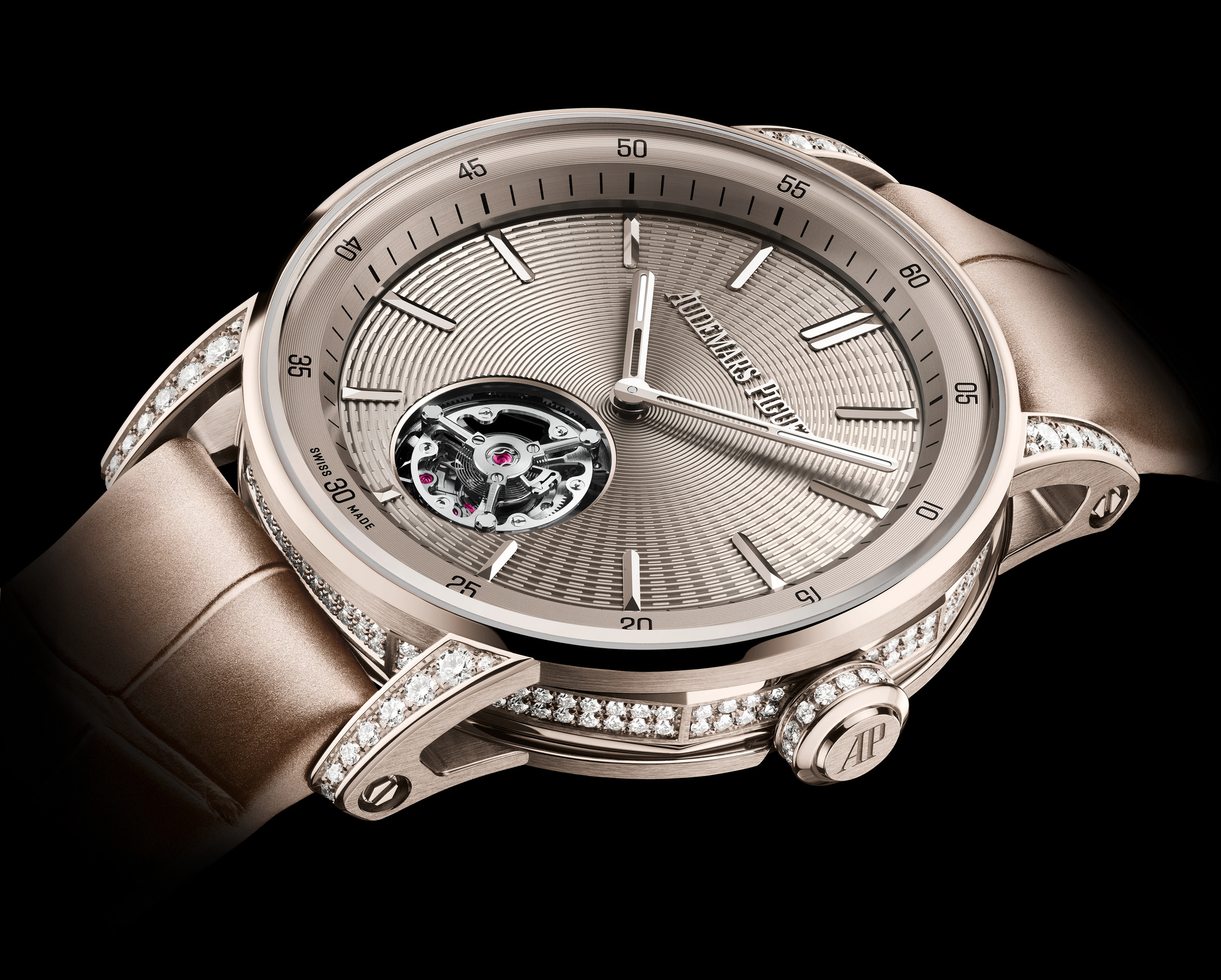 Code 11.59 by Audemars Piguet Selfwinding Flying Tourbillon 38mm 18-carat sand gold
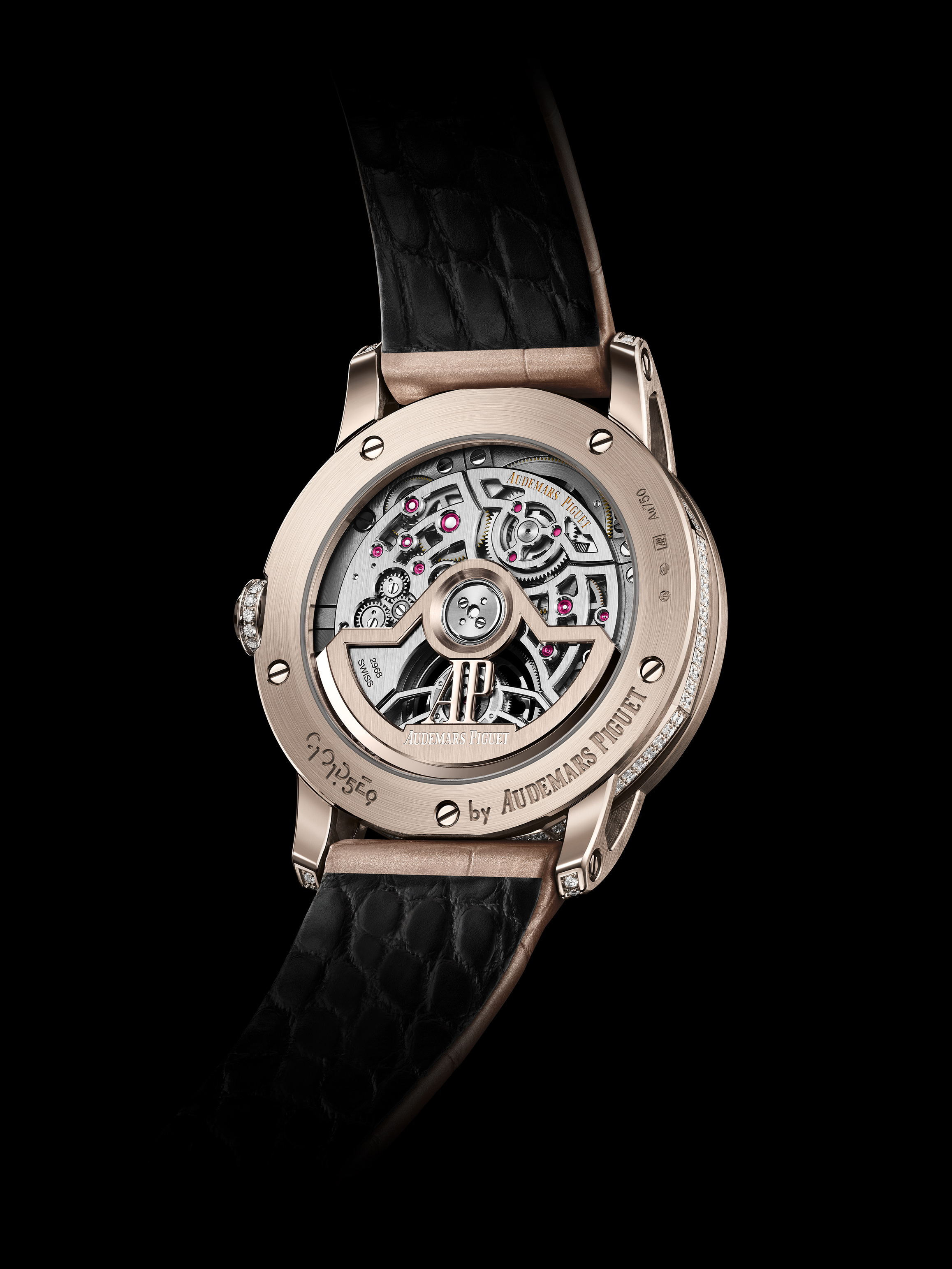
If the Selfwinding Flying Tourbillon Chronograph is the muscular expression of technical robustness, the 38mm Selfwinding Flying Tourbillon is its softer, more glamorous counterpoint. It brings a distinctly feminine elegance to the complication, balancing delicate proportions and jewellery-like detailing with the mechanical expertise for which an established Manufacture is renowned.
The case is alluring in its quiet refinement, combining 18K Sand Gold — an alloy of yellow gold, copper and palladium — with 235 brilliant-cut diamonds totalling approximately 1.2 carats, set across the case middle, lugs and crown. At just 9.6mm thick, its profile is marvellously slim, thanks to the ultra-thin Calibre 2968, part of the RD#3 movement family first introduced in 2022 in a 39mm Royal Oak “Jumbo” and subsequently, a 37mm model. Turn the watch over and the bridges reveal a contemporary “traits tirés” finish, complemented by a Sand Gold-toned 22K pink gold rotor.
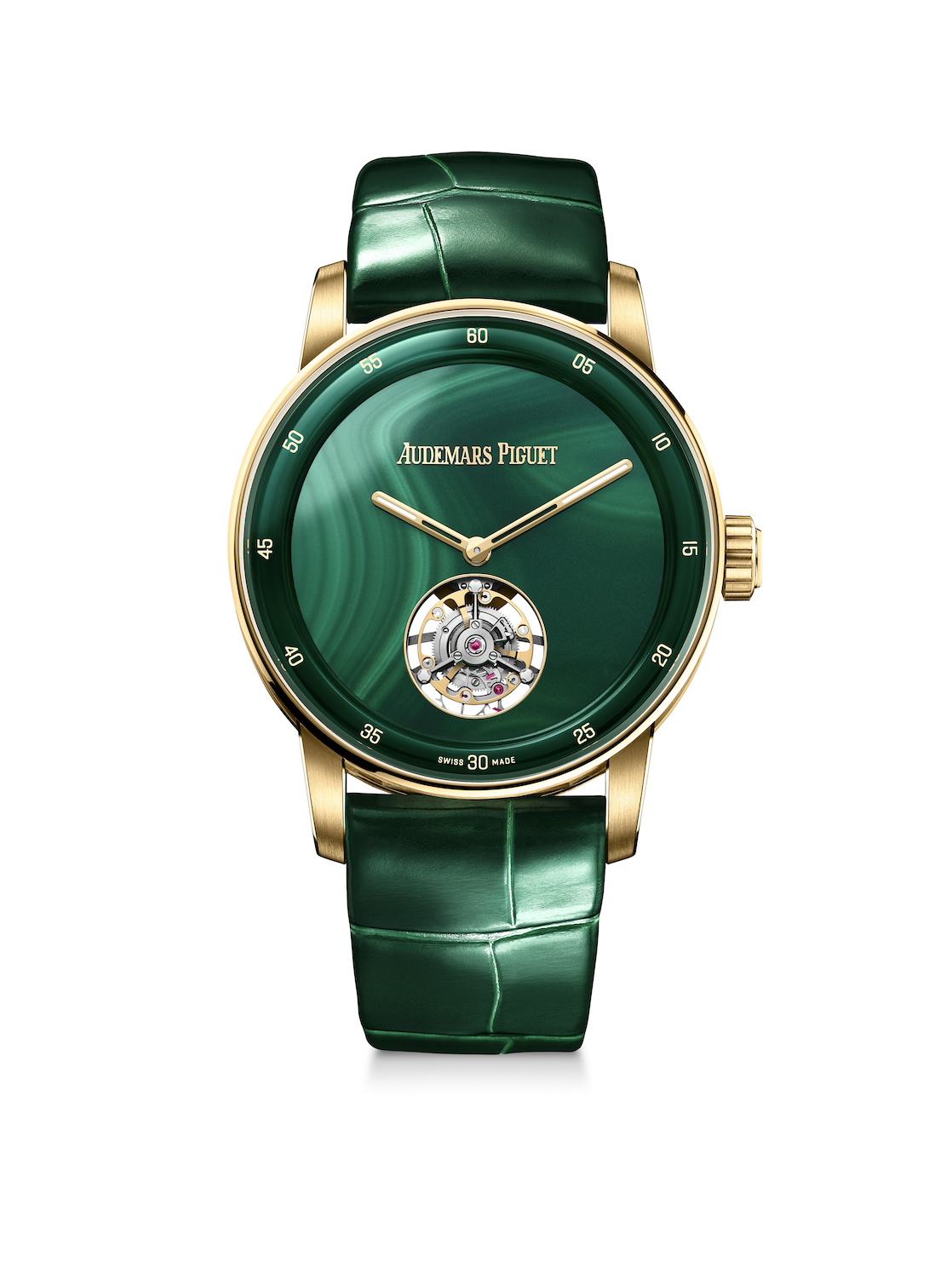 Code 11.59 by Audemars Piguet Selfwinding Flying Tourbillon 38mm 18-carat yellow gold with green malachite
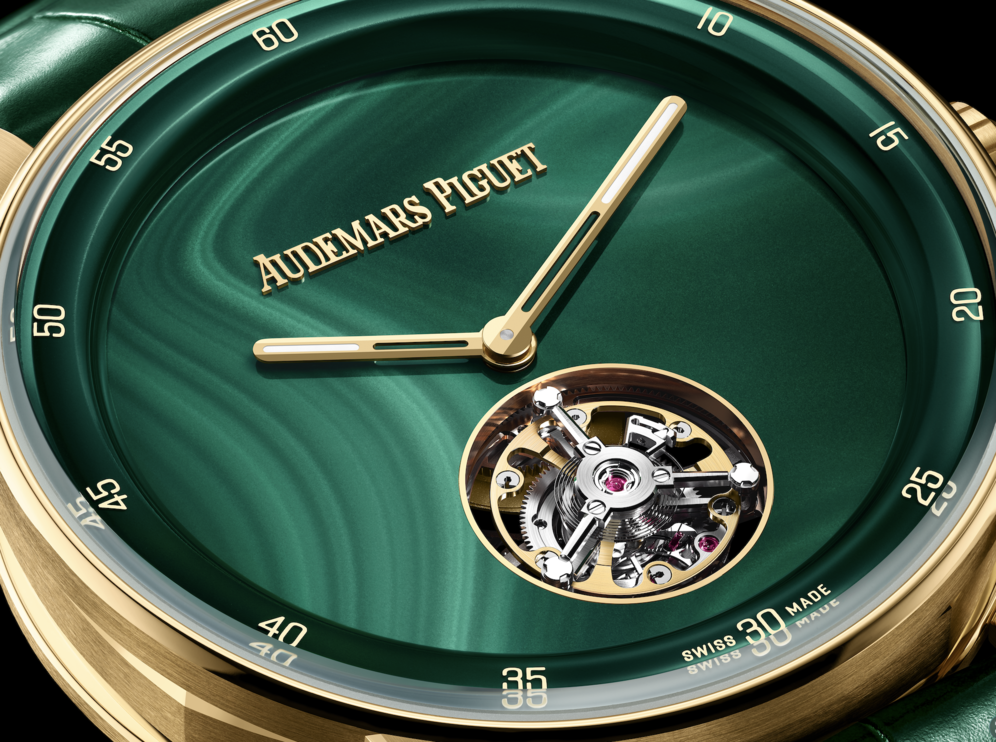
Sparkle isn’t the only way to make a statement. Last year, Audemars Piguet marked its 150th anniversary with a limited-edition trio of 38mm flying tourbillons distinguished by stone dials: 18K white gold with ruby root, 18K pink gold with blue sodalite, and, pictured here, 18K yellow gold with green malachite.
Audemars Piguet has been crafting stone dials since the 1960s, steadily honing its expertise in working with these inherently delicate materials. Each dial begins as a wafer-thin slice of stone, which must be cut and polished with painstaking care to avoid breaking or chipping, while the section itself must be chosen for its richness of colour and distinctive variations in tone and veining.
The result is a natural beauty that makes every dial unique. The stones also carry their own symbolism: Green malachite, for instance, is traditionally associated with growth and transformation. Beneath that organic character, the technical credentials remain intact: Calibre 2968 beats at 3Hz and offers a 50-hour power reserve.
Whether rendered in ceramic, gold, diamonds, or stone, Audemars Piguet’s execution of its flying tourbillon showcases distinct personalities around a singular complication.
Discover more at AP House Singapore or the AP Boutique at Liat Towers







 Back