



But yet, the nagging sense persists anyway.
The wellness industry’s foundational problem – and it has been industriously avoiding solving it for years – is that it has become good at telling you how you are doing and less interested in what to actually do about it. Diagnostics have never been more sophisticated: Biomarker panels, epigenetic clocks, and whole-body imaging that can map your visceral fat distribution with uncomfortable precision. The intervention playbook, however, remains for most providers a tastefully branded collection of educated guesses, delivered in a handsome space and invoiced accordingly.
Singapore’s longevity ecosystem is among the world’s most concentrated. Public anchors in NUS and Alexandra Hospital make up one end of the field; an increasingly dense private field – from Chi Longevity to a wave of new concept centres that opened across 2025 and 2026 – the other. And yet the central problem persists across almost all of it: Measurement and action operate in separate rooms.
PORTFOLIO GETS PERSONAL
Inside Elyx Life, Singapore’s New USD$150,000-Membership Concierge Healthspan Service
11 May 2026
The wellness industry has never been better at measuring what ails you. Elyx Life, Singapore’s first healthspan concierge service, is more interested in what to actually do about it.

There is a particular kind of exhaustion that only afflicts the very dedicated. You have done the retreat in Kamalaya. You read every newsletter Bryan Johnson drops. You wear the continuous glucose monitor with the resigned commitment of someone who has heard too many longevity podcasts, and you consume your supplement stack each morning with the joyless efficiency of a person who has spent considerable money being told what they already suspected: That sleep matters, that processed food is bad, and that stress is quietly doing damage in ways you cannot measure without spending more. You are, by most metrics, optimised.

- THE BIT NOBODY PUTS ON THE BROCHURE
- YOU CANNOT SIMPLY PAY TO PLAY
- YOUR BMI IS NOT THE REASSURANCE YOU THINK IT IS
- WHAT YOU ARE ACTUALLY PAYING FOR
The Bit Nobody Puts on the Brochure
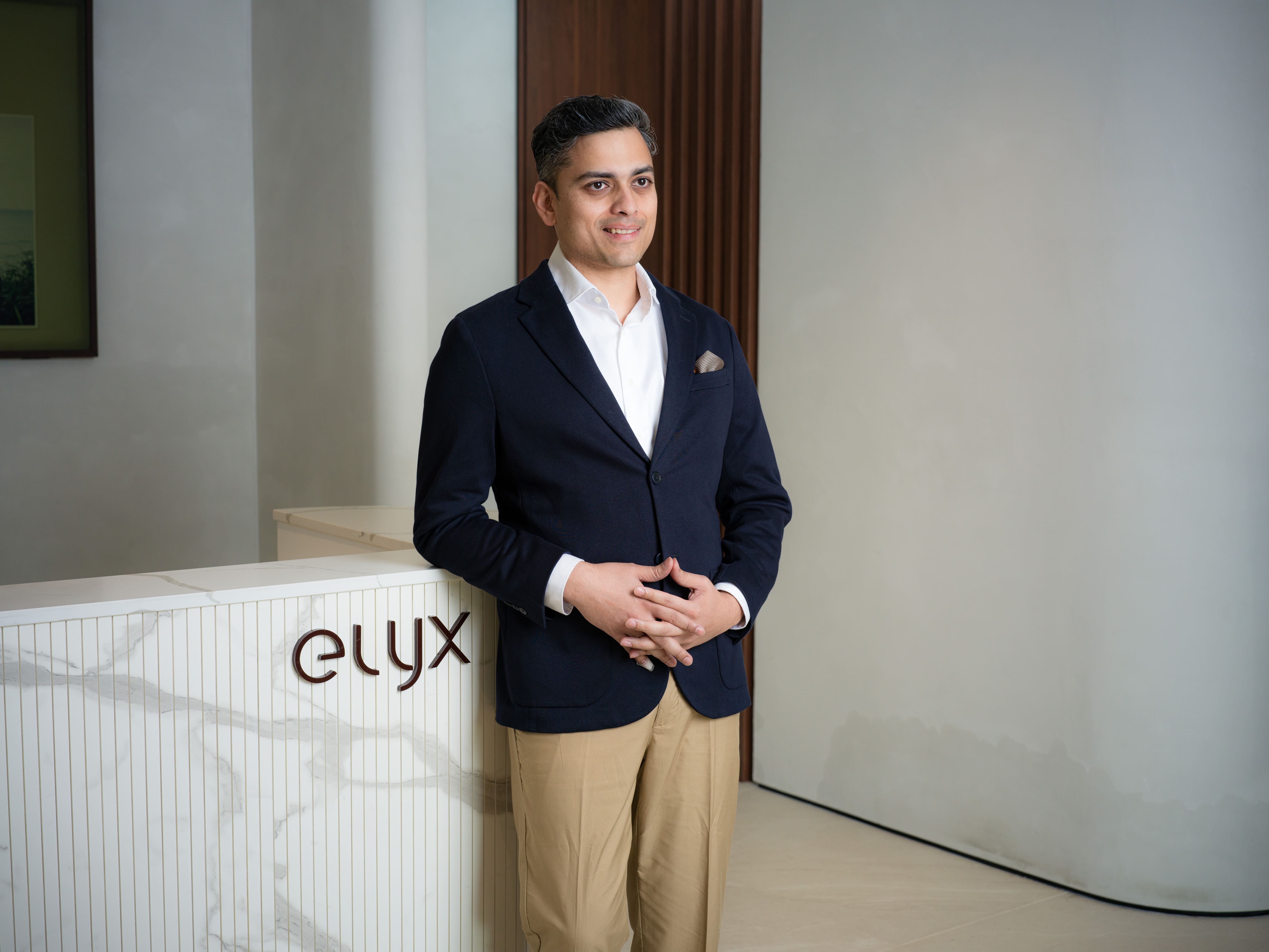 Dr. Varun Reddy
Dr. Varun Reddy, clinician-scientist and Chief Medical Officer of Elyx Life, is not a man who oversells. He is also, which is rarer in this industry, not a man who dresses up the ordinary in borrowed sophistication.
Asked to separate the areas of healthspan optimisation, supported by evidence from those running on commercial momentum, he doesn’t reach for the glossy end of the menu. “The most effective therapeutic levers remain fundamentally unglamorous,” he says. “Driving down ApoB to radically alter the trajectory of atherogenesis and treating exercise – specifically VO2 max and the preservation of functional muscle fibre – as the potent pharmaceuticals they are.”
The more photogenic corners of the industry prefer to anchor their pitch in biological age clocks, NAD+ infusions, and peptide protocols with promising mechanisms and preliminary human data. Dr. Reddy is frank about the latter: For the vast majority of such interventions, clinical efficacy data for tangible healthspan outcomes remain, in his assessment, “stubbornly preliminary.”
The diagnostic fetish comes in for similar scrutiny. “A standard diagnostic is a static photograph plotted against a bell curve,” he observes. “It tells us what your systems were doing last Thursday, but reveals little about your biological velocity.” For a sector that has built considerable commercial architecture around the one-off assessment, it is a pointed observation. Measurement without longitudinal context is not precision medicine, but just expensive orientation.
When a member arrives convinced by a podcast that they require a specific experimental protocol, the response is neither an obliging prescription nor a flat refusal. “We channel their curiosity into a structured empirical framework,” Dr. Reddy says, “ensuring we do not squander their biological bandwidth on elegant theories that fail to deliver.” The N-of-1 methodology at the model’s core formalises this instinct: Define the targets, apply the intervention, quantify the response, and abandon the hypothesis if the data doesn’t support it.
- THE BIT NOBODY PUTS ON THE BROCHURE
- YOU CANNOT SIMPLY PAY TO PLAY
- YOUR BMI IS NOT THE REASSURANCE YOU THINK IT IS
- WHAT YOU ARE ACTUALLY PAYING FOR
You Cannot Simply Pay To Play


It is into the gap Dr. Reddy describes that Elyx Life opened in January 2026 at the Raffles Hotel Arcade. The address signals a particular register of seriousness – and a statement about who this is for and what it expects of them.
The facility makes its argument without raising its voice. Clinical-grade performance equipment – Woodway treadmills, Vald force platforms for strength profiling, functional movement assessment bays – sit alongside a hyperbaric oxygen chamber, red-light therapy, a private Finnish sauna, and cryotherapy. Adjacent is Elyx Medical, a physician-led diagnostics suite: Comprehensive biomarker panels, advanced imaging, physician consultations. Physicians then assess the performance data to arrive at refined protocols.
At USD$150,000 annually, membership is not a number designed for hesitation – nor one you can simply pay. Every prospective member begins with a suitability assessment conducted by Dr. Reddy personally before any place is confirmed, committing to a fifty-member cap.
The co-founders came to longevity medicine via a shared conviction rather than a clinical one. Peng T. Ong, Chair, co-founded Monk’s Hill Ventures, one of Southeast Asia’s more considered technology funds; CEO Ashish Chordia built LG Ads – formerly Alphonso – on the premise that genuine personalisation requires infrastructure most users never see. Their translation to healthspan is less a pivot than a continuation: The problem, as both see it, has never been data, but coordination.
- THE BIT NOBODY PUTS ON THE BROCHURE
- YOU CANNOT SIMPLY PAY TO PLAY
- YOUR BMI IS NOT THE REASSURANCE YOU THINK IT IS
- WHAT YOU ARE ACTUALLY PAYING FOR
Your BMI Is Not the Reassurance You Think It Is
The most intellectually substantive case Elyx makes – and the one most specific to its Southeast Asian membership – concerns the provenance of the science underlying most longevity protocols. Most of the research has been built on Western cohort data, and the clinical thresholds it produces are calibrated accordingly. Asian physiology, Dr. Reddy notes, does not always comply.
“Asian populations exhibit more fragile pancreatic beta cells and a higher propensity for visceral fat,” he says. “If we relied purely on imported Western algorithms, we would routinely clear patients at a BMI of 23 whilst significant visceral fat accumulation and metabolic dysfunction progressed undetected.”
For a service operating across Singapore and Southeast Asia, this is not a theoretical nuance – it is the difference between medicine calibrated to actual physiology and repurposed protocols with a regional letterhead applied. Singapore’s 83-year average life expectancy alongside approximately 75 healthy years represents a gap that is simultaneously a public health challenge, a national policy priority, and the commercial rationale for the dense private ecosystem assembling around it.
(Related: Spaces that rethink the wellness routine)
- THE BIT NOBODY PUTS ON THE BROCHURE
- YOU CANNOT SIMPLY PAY TO PLAY
- YOUR BMI IS NOT THE REASSURANCE YOU THINK IT IS
- WHAT YOU ARE ACTUALLY PAYING FOR
What You Are Actually Paying For

Here is the question the feature would be derelict not to ask. If you are already disciplined, well-read, wearable-equipped, and sleeping eight measured hours – what, precisely, are you buying for USD$150,000 a year, after a personal assessment by the Chief Medical Officer, in a service that has deliberately capped its own growth to protect its standard of care?
Dr. Reddy answers it with the least flattering version first: A committed individual, he concedes, can probably approximate a meaningful portion of this alone. What he doesn’t concede is the part that matters. Human physiology is adversarial. The intervention you deploy to modulate one pathway will compensate elsewhere, sometimes usefully, sometimes not, in ways that take months to surface and require a clinician with full-picture oversight to catch. Self-directed optimisation, pursued with zero external accountability, is not a programme. It is an uncontrolled, largely unreliable, experiment in which the scientist and the subject are the same person.
What Elyx is selling, stripped of the facility and the concierge layer and the AI co-pilot, is the one thing the wellness industry’s most zealous consumers have systematically failed to buy: Someone whose professional obligation is to the outcome rather than to the enthusiasm. At USD$150,000 a year, that is either an extraordinary indulgence or the only logical conclusion of taking your health seriously.
Singapore is the city that turned an eight-year gap between life expectancy and healthy years into a policy target, built the public infrastructure to address it, and then watched the private sector arrive to price the same argument for those who prefer not to wait. That those two impulses – the collective and the unapologetically individual – coexist here without contradiction is not incidental. It is, more or less, the city’s entire operating thesis.



 Back
Back